

ROMAN Consulting Group
Fractional Project Controls
Most owners don't lack project controls. They lack the right amount of it, applied at the right time. Many either bring in full controls capability too early, before there's enough scope definition to act on, or wait too long, until contractor oversight responsibilities are already piling up with no dedicated resource watching schedule updates, cost variance, or change orders in real time. ROMAN Consulting Group provides fractional project controls, matching qualified, part-time controls support to what each FEL stage actually requires, function by function, rather than treating it as an all-or-nothing staffing decision.
What Is Fractional Project Controls?
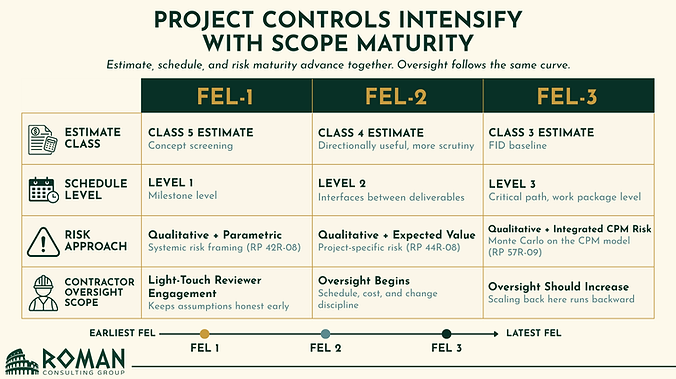
Fractional project controls is not a staffing model. Staffing implies headcount, placement, and filling a seat. This is closer to engaging a qualified specialist only for the specific function and level of effort a project actually needs at a given stage, the way a company might retain outside counsel or an independent auditor rather than hire one internally. AACE International's classification systems tie estimate class, schedule level, and risk assessment type to the same underlying driver: the degree of project definition available at the time. As scope matures from FEL 1 through FEL 3, the estimate, schedule, and risk process should mature with it, and controls oversight should follow the same curve.
Our Approach
FEL 1 — Screening Discipline — a light-touch, fractionally engaged review keeping Class 5 estimate assumptions honest and risk framed qualitatively (AACE RP 62R-11, 63R-11), before those assumptions anchor later decisions. This is the moment when overconfidence in an early number is cheapest to correct and most expensive to leave unchallenged
FEL 2 — Where Oversight Starts to Earn Its Keep — Class 4 estimate scrutiny, a Level 2 schedule showing deliverable interfaces, and quantitative risk work using expected value methods (AACE RP 44R-08), the stage where engineering contractor oversight typically begins in earnest
FEL 3 — The FID Baseline — Class 3 estimate and Level 3 schedule rigor sufficient to support full funding authorization, with integrated cost and schedule risk analysis (AACE RP 57R-09) now possible against a real critical path network
Contractor Oversight Across FEL 2 and FEL 3 — three functions carrying most of the weight: schedule update review (AACE RP 53R-06), progress and cost oversight against an earned value baseline (AACE RP 82R-13, 86R-14), and contract change management testing entitlement, causation, and quantum (AACE RP 100R-19)
The fractional model applies function by function, not as an all-or-nothing package. An owner might keep schedule review in-house, where the team already has visibility, and bring in fractional support specifically for change management, where an outside, disinterested read on entitlement and causation tends to matter most. A practical self-check: if a contractor's schedule update, cost report, or change order request currently gets accepted by whoever on the owner's team happens to have time that week, rather than by someone trained to test it against the relevant AACE standard, that gap is exactly what fractional oversight is built to close.
Built for Projects Without a Standing Controls Function
Owners who bring in full controls capability too early, before there's enough scope definition to act on, or too late, once contractor oversight responsibilities are already piling up. Projects where a contractor's schedule update, cost report, or change order gets accepted by whoever has time that week, rather than someone trained to test it. Organizations that need controls capability matched to FEL stage, not a permanent full-time seat.
Case Study
A mid-size owner brought in full-time project controls staff at FEL 1, well before there was enough scope definition for the role to add value, then found the same team stretched too thin by FEL 2 to properly review contractor schedule updates or test change order causation. ROMAN restructured the engagement around FEL-stage need: a light-touch fractional reviewer at FEL 1 to keep Class 5 assumptions honest, then dedicated fractional support for schedule review and change management specifically once the EPC contractor began detailed engineering at FEL 2. When a contractor submitted a change order citing a field condition as cause, ROMAN's review found the actual driver was the contractor's own sequencing decision, failing the causation test despite a defensible cost figure. The change order was rejected on that basis, a distinction the owner's stretched internal team would likely have missed.
Frequently Asked Questions
Q. What is fractional project controls?
A. Fractional project controls is a resourcing model in which qualified, part-time controls support is matched to what a project actually needs at each FEL stage, rather than committing to full-time headcount regardless of workload.
Q. How does estimate class relate to schedule class?
A. Both are driven by the same underlying factor: degree of project definition. AACE RP 18R-97 defines estimate classes on this basis, and AACE RP 37R-06 defines schedule levels of detail on a parallel curve, so a Class 4 estimate is typically paired with a Level 2 schedule, and a Class 3 estimate with a Level 3 schedule capable of supporting a real critical path network.
Q. When should engineering contractor oversight begin?
A. Contractor oversight of schedule updates, cost variance, and change orders should begin at FEL 2, when contractor engagement on engineering scope typically starts, and should continue through FEL 3 rather than being scaled back once a Class 3 estimate and Level 3 schedule are being finalized.
Q. Does fractional mean reduced quality?
A. No. Fractional refers to time commitment, not rigor. A fractional reviewer applying AACE-aligned recommended practices can catch the same issues a full-time resource would, provided the engagement is scheduled with enough discipline to match the project's actual reporting cadence.
Related Reading


