

The Lang Factor in Capital Project Estimating (Part 1): Why It Breaks Down in Modern Projects

Updated: Jan 29
Introduction
In the 1940s, Hans J. Lang published three papers that collectively introduced a simplified methodology for estimating the total capital investment of new chemical industrial plants during the initial design stage [1–3]. His methodology correlated total plant costs to the cost of major process equipment through the application of a single multiplier.
Although originally intended for early project screening, the Lang Factor is frequently interpreted today as a proxy for Total Project Cost (TPC). This interpretation has contributed to widespread confusion, inconsistent application, and unrealistic expectations regarding estimate accuracy. Construction practices, safety requirements, automation, regulatory oversight, and owner involvement have changed significantly since the late 1940s.
This paper provides an in-depth examination of the context surrounding Lang’s publications and his three original Lang Factors. The intent is to clarify what Lang’s work represented, what it did not represent, and why misunderstanding persists in modern estimating practice.
Scope and Intent of This Paper
This paper examines the historical basis, scope content, and statistical limitations of the traditional Lang Factor as presented in Hans J. Lang’s original publications and as interpreted in modern estimating practice [1–3]. It does not propose a replacement estimating methodology, nor does it attempt to recalibrate Lang-type factors for contemporary use. Rather, it establishes boundaries for credible application of Lang-type factoring methods within modern AACE Class 5 estimating and clarifies why such methods should not be interpreted as proxies for Total Project Cost under current project execution, regulatory, and cost structures [4,5].
For the purposes of this paper, the terms Total Project Cost (TPC) and Total Plant Cost are treated as equivalent and represent the full capital investment required to design, construct, commission, and place a facility into operation, including owner-incurred costs and start-up activities. To reduce ambiguity, the term Total Project Cost (TPC) is used throughout this paper.
Part 1 – The Problem
This paper focuses on identifying and documenting the fundamental issues associated with the continued use and interpretation of the Lang Factor as a Total Project Cost estimating tool.
Initial Findings
The “Lang Factor” remains a foundational tool for generating initial partial project cost estimates, rather than Total Project Cost estimates [1–3]. Modern classification of Lang-type factoring methods aligns them with AACE Class 5 estimating, which is characterized by limited scope definition and wide characteristic accuracy ranges [4,5].
Lang emphasized that his cost data in the October 1947 publication were for “complete plants” and that the September 1947 publication was “exclusive of fee.” In his third publication, he labeled the resulting estimates as “Total Estimated Plant Cost” [1–3]. While the terminology evolved across the three publications, the underlying scope content did not materially change.
The notion of “complete plant” or Total Project Cost is therefore inconsistently applied in modern interpretations of Lang’s work. A common assumption among project professionals is that the Lang Factor cost-estimating methodology supports the development of Total Project Cost estimates. This assumption is inconsistent with both the documented scope of Lang’s original datasets and modern AACE estimate classification guidance [1–3,4,5].
Further, Lang’s methodology lacks the rigorous scope definition, cost segregation, and dataset transparency required for modern precision in Total Project Cost estimation as defined by AACE factored estimating and estimate classification guidance [4,5]. By focusing primarily on core process equipment, the factors omit critical off-site requirements and other significant project cost elements, including owner-incurred costs. Consequently, the published Lang Factors fail to meet the statistical reliability standards demanded by today’s investors and project stakeholders.
Limitations of the Lang Factor
Despite its continued use, the Lang Factor has inherent limitations that restrict its applicability in modern estimating practice. These limitations stem from the characteristics of the original dataset, the scope content implicitly represented by the factor, and the evolution of industrial project execution since Lang’s original publications.
A primary limitation of the Lang Factor is the size and composition of the underlying dataset. Lang’s factors were derived from a relatively small number of projects, many of which were conceptual, experimental, or not fully constructed at the time of publication. Lang acknowledged this limitation explicitly, noting that several conclusions were based on insufficient data and that the results were intended to be more reliable than an outright guess rather than statistically rigorous predictions [1–3].
In addition, the scope content embedded within the Lang Factors is not explicitly defined. While Lang referred to “complete plants” and “total estimated plant cost,” the publications do not clearly delineate the inclusion or exclusion of Outside Battery Limits, owner-incurred costs, or commissioning and start-up activities. This ambiguity has contributed to inconsistent interpretation and application of the factors in later practice [1–3].
Another important limitation is the evolution of industrial facilities and execution practices since the late 1940s. Modern process plants incorporate significantly greater levels of automation, safety systems, environmental controls, and supporting infrastructure than those reflected in Lang’s original dataset. Regulatory requirements, labor practices, construction methodologies, and owner involvement have also changed substantially. These changes have altered cost structures in ways that are not captured by a single equipment-based multiplier.
As a result, Lang-type factors do not satisfy the requirements for precision estimating under modern conditions. They lack the scope segregation, normalization, and transparency required to support Total Project Cost development or to meet the expectations associated with contemporary estimate classification standards [4,5].
Nevertheless, when applied within their intended context, Lang-type factors can still provide value as early-stage screening tools. Their limitations do not invalidate their usefulness, but rather define the boundaries within which they should be applied. Understanding these limitations is essential to preventing misuse and to ensuring that early-stage cost estimates are interpreted appropriately by project stakeholders.
Evolution of Scope and Content Across Lang’s Publications
Hans J. Lang published three papers between 1947 and 1948 that collectively introduced and refined what later became known as the Lang Factor. Although these papers are frequently cited together, the scope descriptions, terminology, and cost bases evolved across the publications, contributing to later misinterpretation of their intended application.
In the September 1947 publication, Lang presented cost relationships described as being “exclusive of fee,” focusing on estimating approaches applicable during early design stages [1]. The October 1947 publication expanded on this work and introduced references to “complete plants,” a term that was not formally defined and has since been interpreted inconsistently [2]. In the June 1948 publication, Lang referred to “Total Estimated Plant Cost,” further reinforcing the perception that the factors represented comprehensive project costs [3].
Despite these shifts in terminology, the underlying datasets and estimating approach remained largely unchanged across the three publications. The cost information continued to be derived primarily from major process equipment and associated installation costs, without explicit segregation of supporting infrastructure, owner-incurred costs, or commissioning and start-up activities. As a result, the apparent expansion in scope implied by the terminology was not supported by a corresponding expansion in documented cost content.
Lang himself acknowledged the limitations of the data and cautioned against overinterpretation. In the final publication, he noted that many conclusions were based on insufficient data and that the intent was to provide estimates that were more dependable than an outright guess rather than statistically precise forecasts [3]. This acknowledgment is often overlooked in later interpretations of the Lang Factors.
The evolution of language across Lang’s publications, combined with the absence of explicit scope definitions, has contributed to ongoing confusion regarding what the Lang Factors represent. Subsequent authors and practitioners have frequently treated the factors as proxies for Total Project Cost, despite the lack of supporting evidence in the original work. Understanding how scope and terminology evolved across Lang’s publications is therefore essential to properly contextualizing their use in modern estimating practice.
Key Goals of the Lang Method
The Lang Factor was developed to address practical challenges associated with estimating industrial process plants during the earliest stages of project development, when limited information is available and rapid decision-making is required. The method was not intended to produce detailed or definitive project cost estimates, but rather to support early evaluation of feasibility, scale, and relative economics.
The key goals of the Lang Method include the following.
Early Project Screening
One of the primary goals of the Lang Method was to enable rapid screening of potential projects during conceptual development. By relating total plant cost to the cost of major process equipment, the method provided a means to quickly approximate overall investment requirements without extensive design effort.
This capability allowed project sponsors and engineers to compare alternative process concepts, plant capacities, or technology options before committing resources to more detailed studies. In this context, the Lang Factor served as a practical screening tool rather than a substitute for later-stage estimating.
Simplification of Complex Cost Calculations
Another key objective of the Lang Method was to simplify complex cost calculations associated with industrial facilities. Detailed bottom-up estimating requires significant engineering definition, data availability, and time, which are typically not available during early project phases.
By collapsing numerous cost elements into a single multiplier applied to major equipment cost, the Lang Method reduced computational complexity and made early cost estimation accessible to a broader audience of engineers and decision-makers. This simplification was particularly valuable in an era when computational tools and cost databases were limited.
Project Budgeting and Investment Guidance
The Lang Method also supported preliminary project budgeting and investment guidance by providing order-of-magnitude cost estimates suitable for high-level financial evaluation. These estimates helped frame early discussions related to capital availability, project prioritization, and strategic alignment.
While not intended to establish firm budgets or final investment decisions, Lang-type estimates offered a starting point for assessing whether a proposed project warranted further development. When used within this limited context, the method contributed to disciplined capital planning and informed progression through early project stages.
The Basis, Use, and Accuracy of the Lang Factors
Understanding the original intent of the Lang Method provides necessary context for evaluating the basis, use, and accuracy of the published Lang Factors.
Hans J. Lang issued two sets of Lang Factors in his publications, one in October 1947 and another in June 1948. The factors published in June 1948 are generally assumed to represent the final version of the Lang Factors.
The calculated averages based on the September and October 1947 published data are as follows:
· Fluid plants = 3.56
· Solid plants = 3.19
· Solid and fluid plants = 3.20
The final (“black box”) factors published in June 1948, without supporting data, are:
· Fluid plants = 4.74
· Solid plants = 3.63
· Solid and fluid plants = 3.10
Hans Lang intended the June 1948 factors to support reasonably reliable preliminary estimates. One or both sets of published Lang Factors have since become widely cited in the fields of process engineering and cost estimation.
The formula for the Lang Factor is:
Total Equipment Cost (TEC)
×
Applicable process Lang Factor (Fluid, Solids, or Solids & Fluids)
=
Total Project Cost (TPC)
Despite its simplicity, this formulation has contributed to persistent misunderstanding regarding what portion of project scope and cost is represented by the resulting estimate.
AACE International Recommended Practice 59R-10 notes that the accuracy of the Lang method is least dependable for Outside Battery Limits and off-site costs, which are highly variable, and associates it with a Class 5 estimate accuracy range of approximately minus fifty percent to plus one hundred percent [4][5].
Accuracy can be improved in practice, in some cases approaching Class 4 estimate ranges, when multipliers are derived from an organization’s historical data and Outside Battery Limits scope and cost are treated separately. In such cases, the methodology more closely resembles an Equipment Factored Estimate rather than a direct application of the traditional Lang Factor.
Beneficial By-Products
While the Lang Factor is frequently misapplied in modern estimating practice, its historical use has produced several beneficial by-products that continue to influence how early-stage project costs are evaluated and communicated. These by-products are not inherent to the Lang Factor itself, but rather to the discipline of early-stage estimating and the recognition of uncertainty associated with limited project definition.
Awareness of Cost Estimate Relationships
One of the beneficial by-products of the Lang Factor and related early-stage estimating methods is increased awareness of cost estimate variance and financial risk among project stakeholders and investors.
Early-stage cost estimates are inherently uncertain due to limited scope definition, incomplete design information, and unresolved execution and site-specific factors. The use of factored estimating techniques reinforces the understanding that early estimates represent a range of possible outcomes rather than a single deterministic value.
By explicitly acknowledging this uncertainty, early-stage estimates help frame investment discussions around risk exposure, capital flexibility, and decision timing. This awareness supports more informed screening decisions and encourages stakeholders to defer detailed financial commitments until additional project definition is achieved.
While the Lang Factor itself is often misapplied, its historical role in highlighting the magnitude of early-stage uncertainty has contributed positively to modern cost estimating practice by emphasizing the importance of recognizing uncertainty rather than obscuring it through overly precise point estimates.
Communicating Cost Estimate Variance and Risk to Investors
The ± accuracy range associated with early-stage estimates is critical for transparently communicating potential cost variance and risk to investors.
A preliminary Equipment Factored Estimate, which aligns with AACE Class 4 estimating, typically carries a characteristic accuracy range of approximately +50% / −30%. This range establishes the necessary boundaries for early-stage decision-making through the use of a Three-Point Estimate. Establishing an explicit ± accuracy range is essential for communicating potential cost variability and systemic risk to investors [5].
By contrast, final project pricing typically targets a much narrower accuracy range, often on the order of ±10%, and is developed only after sufficient project definition exists. Under current AACE International guidance, a Class 4 estimate carries a characteristic accuracy range of +50% / −30%, reflecting the level of project definition and maturity at this stage [5].
This methodology enables the development of a Three-Point Estimate comprising Optimistic, Most Likely, and Pessimistic scenarios, which together define the preliminary financial boundaries investors should anticipate.
For example, a $1 million estimated cost derived using a Lang-type factor indicates a probable final expenditure between approximately $0.7 million and $1.5 million.
This approach establishes realistic preliminary financial boundaries for investors and provides early visibility into potential exposure well in advance of later-stage estimates, which are typically developed once sufficient definition exists to support pricing with much narrower accuracy ranges.
Key Elements Defining the Scope of Factored Cost Estimates
Several design deliverables are essential to defining the completeness of scope represented by factored cost estimating methodologies for industrial process plants. These deliverables establish what is included in the estimate and, equally important, what is excluded. Because factored estimating methods rely on early process definition, understanding how scope boundaries are formed during initial design is critical to interpreting the resulting cost estimates.
Process Flow Diagrams
At the early onset of process development, a Process Flow Diagram (PFD) is prepared by a chemical process engineer to establish the fundamental process concept. The PFD defines the sequence of process steps, major equipment items, stream connections, and key operating conditions that collectively describe how the facility is intended to function. An example Process Flow Diagram is shown in Figure 1.
The PFD establishes the conceptual process boundaries and serves as the primary reference for subsequent equipment sizing, layout development, and preliminary cost estimation. At this stage, the PFD is inherently process-centric and does not define detailed piping, instrumentation, electrical systems, or supporting infrastructure, all of which are addressed in later phases of project development.

Sized and Priced Major Process Equipment Lists
Using the PFD, chemical process simulations, and an initial heat and material balance, the process engineer develops a sized major process equipment list. This list identifies the core process units required for production, such as reactors, distillation columns, compressors, heat exchangers, and major vessels. These equipment items represent the primary physical assets required to execute the process defined by the PFD.
Once identified and sized, the major equipment items are tabulated and conceptually priced for cost estimating purposes. It is not unusual for process engineers to apply a 10 percent to 20 percent design margin to equipment sizing for operational considerations such as turndown requirements, future capacity expansion, or process flexibility. Any such margins should be documented on the equipment list, including the specific margin applied and its technical justification, as they directly influence subsequent cost estimates.
The quality and date of the equipment cost estimates are important and should be clearly identified. Cost data quality can significantly influence the accuracy of the resulting factored cost estimate, in some cases by 30 percent or more. Typical cost quality levels encountered at this stage include undocumented phone or verbal quotations, rough order-of-magnitude estimates, historically scaled and escalated costs, or simple allowances.
Preliminary Plot Plans
A preliminary plot plan of equipment layouts is created to visualize the process design concept in physical space. The plot plan provides approximate spatial coordinates and establishes preliminary physical boundaries, commonly referred to as battery limits, for manageable areas of the facility.
These equipment arrangement sketches support early evaluation of interconnecting piping requirements and constructability considerations. At this stage of design, the specific plant site location and infrastructure requirements are often unknown. While process units are generally site-independent, the eventual infrastructure, utility systems, and supporting facilities are always unique to the final plant location.
Inside Battery Limits
The Process Flow Diagram (PFD) sized major process equipment list, and preliminary plot plan collectively define the process concept boundaries known as the Inside Battery Limits (ISBL). The ISBL scope is formally established through the integration of these three deliverables, which together represent the core process systems required to achieve production.
Collectively, the PFD, equipment list, and preliminary layout delineate the physical and conceptual boundaries of the core process systems. The ISBL boundary represents the point at which the process systems interface with supporting utilities and infrastructure. These boundaries are established early in project development and form the basis for factored cost estimating methodologies.
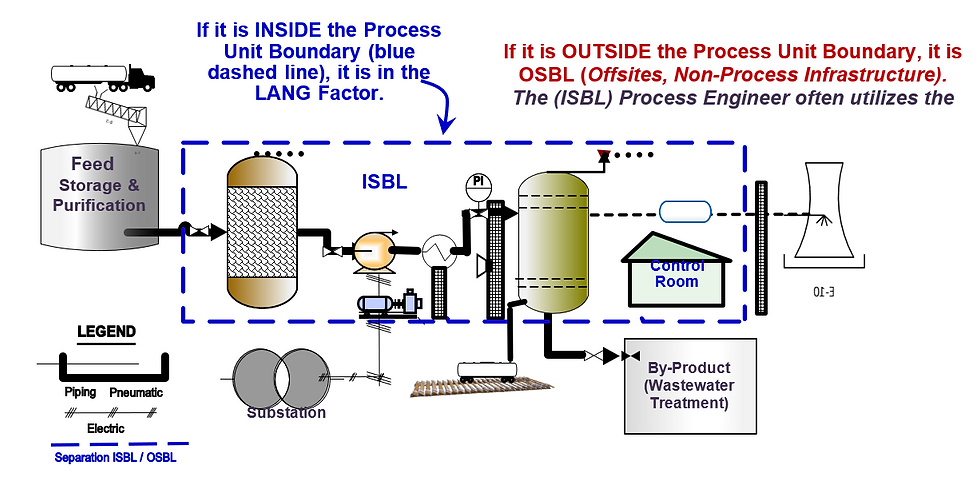
It illustrates the conceptual separation between ISBL and Outside Battery Limits (OSBL), highlighting the distinction between core process systems and supporting non-process infrastructure. While the ISBL scope is defined primarily by process requirements and is largely independent of site location, OSBL scope is highly dependent on site-specific conditions, execution strategy, and operational requirements.
Outside Battery Limits and Non-Process Infrastructure
All non-process plant requirements, including supporting utilities, storage tanks, feedstock handling and purification systems, product storage and packaging facilities, control buildings, substations, security systems, and maintenance facilities, are not fully defined until after the initial process design has been conceptually established.
This portion of the project scope is known as Outside Battery Limits (OSBL) and is more descriptively referred to as Non-Process Infrastructure (NP/I). Unlike ISBL scope, OSBL scope is inherently site-specific and is influenced by numerous factors, including geographic location, execution philosophy, control requirements, regulatory constraints, financial arrangements, start-up requirements, and long-term operations and maintenance strategies.
The rationale for separating ISBL and OSBL scope is both technical and economic. From an investment perspective, this separation enables evaluation of economic metrics such as internal rate of return and net present value while distinguishing chemical process costs from infrastructure-driven variability. From a planning standpoint, ISBL scope definition drives OSBL identification, yet design uncertainty and cost risk are often more pronounced within the OSBL scope of work. In practice, many investment trade-offs, ranging from capital expenditures to operating expenditures, originate within OSBL scope when initial capital investment proves too costly to pursue.
Digging Deeper – Disparity in Lang Source Data
A critical limitation of the Lang Factor arises from the characteristics of the underlying dataset used to develop the original multipliers. The cost data, plant specifications, and project maturity levels identified in Lang’s publications are materially misaligned with modern industrial project requirements. As a result, the dataset lacks the statistical rigor and scope completeness expected by today’s investors, owners, and project stakeholders.
Lang’s second publication provides the most detailed insight into the source data used to develop the Lang Factors. However, closer examination of this dataset reveals significant inconsistencies related to plant scale, project definition, scope completeness, and execution maturity.
A review of the fourteen plants included in Lang’s dataset shows that thirteen of the fourteen facilities were too small to represent full-scale production plants by modern standards. Of the fourteen projects identified, only six were actually constructed, with an average actual cost of approximately $1.7 million at the time. Of these completed projects, one was a fluids plant, two were solids plants, and three were hybrid fluid and solids plants.
All completed projects experienced cost overruns, with actual costs exceeding estimates by approximately 14 percent on average. This indicates that the original estimates were incomplete, even within the limited scope represented by Lang’s methodology.
Five of the fourteen plants were never constructed. Across the full dataset, the average estimated plant cost was approximately $1.9 million, excluding one outlier project estimated at $15 million. The presence of this single large estimate significantly skews the dataset and further undermines its statistical reliability.
In addition, five of the fourteen plants were not representative of full-scale industrial facilities. Two projects were identified as experimental units, and three were pilot plants. These facilities typically require little or no permanent infrastructure and therefore do not align with the concept of Total Plant Cost as understood in modern project development.
Only one project in the dataset included a control room, a notable omission given the central role of control systems in modern process plants. Instrumentation costs were included within major equipment costs, despite instrumentation requirements typically not being defined at early project stages. The basis for determining these instrumentation costs was not documented.
No distinction was made between greenfield projects, expansions, retrofits, or brownfield modifications. Similarly, Inside Battery Limits and Outside Battery Limits costs were not identified, defined, or separated. Other than the explicit exclusion of land cost, no list of cost exclusions was provided. It is therefore likely that several owner-related costs were implicitly excluded, including owner engineering, project management, and the use of existing plant staff.
Construction work practices have also evolved significantly since the 1940s. World War II had just concluded at the time of Lang’s publications, and labor productivity, safety requirements, regulatory oversight, and non-productive work time were substantially different from those encountered in modern projects.
Lang acknowledged these limitations explicitly, stating that his conclusions were “in many cases based on insufficient data” and were intended to be “somewhat more dependable than an outright guess.” This acknowledgment reinforces the importance of understanding the intended context and limitations of the Lang Factors rather than applying them as universal or definitive project cost multipliers.
Key characteristics of Lang’s source dataset are summarized in the table.
Dataset Attribute | Observation from Lang Publications | Implication for Modern Use |
Number of Projects | Fourteen total plants identified | Dataset is small and statistically limited |
Projects Constructed | Six of fourteen plants were built | Majority of data based on unconstructed estimates |
Average Actual Cost (Built Plants) | Approximately $1.7 million | Very small scale relative to modern industrial facilities |
Average Estimated Cost (All Plants) | Approximately $1.9 million, excluding one $15 million outlier | Presence of outlier skews dataset reliability |
Plant Types (Built Projects) | One fluids, two solids, three hybrid | Insufficient representation across plant categories |
Experimental or Pilot Plants | Five plants classified as experimental or pilot | Not representative of full-scale production facilities |
Control Room Inclusion | Only one plant included a control room | Major scope element absent in most cases |
Instrumentation Treatment | Instrumentation included in equipment costs | Basis and timing of instrumentation definition unclear |
ISBL / OSBL Definition | No separation or definition provided | Scope boundaries ambiguous and incomplete |
Project Classification | No distinction between greenfield or brownfield | Limits applicability to modern projects |
Cost Exclusions Identified | Only land cost explicitly excluded | Owner costs and indirects likely omitted |
Cost Performance | Actual costs exceeded estimates by ~14 percent | Indicates incomplete scope |
Construction Era | Post–World War II industrial practices | Not comparable to modern labor and regulatory conditions |
Author Acknowledged Limitations | Conclusions based on insufficient data | Lang cautioned against overreliance |
Final Lang Publication – New Factors
In his June 1948 publication, Hans J. Lang introduced three new Lang Factors without providing supporting data, calculation methodology, or reconciliation with the factors developed in his earlier publications. These revised factors are generally assumed to represent the final version of the Lang Factors, despite their inconsistency with the values derived from the September and October 1947 datasets.
The final factors published in June 1948 differ materially from the calculated averages derived from Lang’s earlier data. Unlike the earlier publications, which included plant descriptions, estimated and actual costs, and relative cost breakdowns, the June 1948 publication presented the revised factors as a consolidated result without explanation of scope, dataset composition, or statistical basis.
This lack of transparency represents a significant departure from Lang’s earlier work. The absence of supporting data prevents independent verification of how the revised factors were developed and whether changes in plant selection, scope assumptions, or weighting methods influenced the results.
When the compiled data from all three Lang publications is examined collectively, additional inconsistencies emerge. Conversion of Lang’s original plant costs from 1947 values to current-year values illustrates the scale mismatch between the dataset and modern industrial projects. Using standard cost index escalation, the conversion from 1947 costs to 2025 costs represents an approximate multiplier of 13.5.
Applying this escalation reveals that the average cost of Lang’s fourteen plants equates to approximately $37 million in 2025 dollars. Only two projects exceed $100 million when escalated to current-year costs. These two projects are the only facilities within the dataset that could plausibly represent standalone, full-scope industrial plants incorporating both Inside Battery Limits and Non-Process Infrastructure.
The remaining projects fall well below the scale typically associated with modern greenfield process facilities. This reinforces the conclusion that the revised Lang Factors, despite being labeled as Total Plant Cost multipliers, are largely derived from small-scale, incomplete, or non-representative projects.
The introduction of new factors without reconciliation to prior datasets contributes directly to the ambiguity surrounding Lang Factor applicability. While these revised factors have been widely cited and replicated in subsequent publications, their undocumented basis makes it difficult to assess their relevance to contemporary project scope, execution practices, and investor expectations.
Research and Commentary
Since the initial Lang publications in the late 1940s, the Lang Factor methodology has been extensively discussed, adapted, and reinterpreted across the process industries. Over the past eight decades, numerous authors and practitioners have proposed alternative multipliers intended to update, refine, or replace the original Lang Factors. These efforts reflect a recurring desire within the industry to establish a simplified, standardized method for estimating early-stage process plant costs.
A broad survey of publicly available literature demonstrates that no single, consistently defined Lang Factor has emerged. Published factors vary widely, with proposed multipliers often ranging from approximately two-thirds to twice Lang’s original values. These variations are frequently presented without clear definition of scope, cost categories, or project maturity, contributing to ongoing confusion regarding applicability and accuracy.
Recent online sources further illustrate this inconsistency. Commonly referenced platforms, including general web searches and publicly editable encyclopedic resources, present conflicting definitions of the Lang Factor, often mixing concepts related to Total Plant Cost, Inside Battery Limits, and Equipment Factored Estimates without distinction. This lack of standardization reinforces the tendency for Lang Factors to be applied beyond their intended context.
Discussions within professional forums, including recent exchanges in the AACE Open Forum, highlight the persistence of these issues. Contributors frequently debate whether Lang Factors should account for Outside Battery Limits, how site-specific considerations influence applicability, and whether a single factor can reasonably represent projects with fundamentally different execution strategies, geographic constraints, and infrastructure requirements.
Several recurring themes emerge from these discussions. One theme is the assertion that Lang Factors resemble other benchmarking metrics in that “one size does not fit all.” Another is the argument that ISBL and OSBL boundaries become blurred when site optimization and infrastructure synergies are considered. A third theme emphasizes that site selection and OSBL definition often occur later in project development, yet strongly influence both capital and operating expenditures.
The wide dispersion of published Lang Factors appears to stem less from disagreement over Lang’s original intent and more from inconsistent interpretation of scope and cost inclusion. Many published multipliers implicitly assume differing definitions of what constitutes a complete plant, often without stating those assumptions explicitly. As a result, comparisons between published factors are frequently invalid, even when numerical values appear similar.
Despite these challenges, the continued interest in Lang-type methods underscores their perceived value as early-stage screening tools. However, the absence of consistent terminology, scope definition, and cost categorization limits their credibility when used as proxies for Total Plant Cost in modern project development.
This body of research and commentary reinforces the central premise of this paper: the Lang Factor has been widely adopted, modified, and cited, yet its foundational assumptions are rarely revisited or clearly articulated. Without that context, the method is vulnerable to misuse, particularly when applied to contemporary greenfield projects with complex infrastructure, regulatory requirements, and owner cost structures.
Other Publications and Interpretations of the Lang Factor
Beyond the original publications by Hans J. Lang, numerous authors and organizations have proposed alternative Lang-type factors or modified equipment factored estimating approaches. These publications reflect continued industry interest in simplified early-stage estimating tools, but they also highlight persistent inconsistencies in scope definition, cost categorization, and intended application.
AACE International has published guidance related to equipment factored estimating through Recommended Practice 59R-10. This Recommended Practice presents factor-based relationships similar in magnitude to Lang’s original values, but with a materially different cost structure. Unlike Lang’s publications, AACE’s framework explicitly separates major cost categories such as piping, instrumentation, electrical systems, labor, materials, and indirect costs, aligning more closely with modern estimating practices.
For liquid process plants, the AACE Recommended Practice factor is approximately 4.63, which is slightly lower than Lang’s final factor of 4.74. For solid process plants, the AACE factor is approximately 15 percent higher than Lang’s published value, while the hybrid fluid and solids factor is approximately 7 percent higher. These differences fall well within the characteristic accuracy range of early-stage estimates and illustrate that numerical similarity alone does not resolve scope ambiguity.
A key distinction in the AACE framework is the explicit inclusion of owner engineering and oversight, which is identified as an additional cost component of approximately 9 percent. This element was not identified or quantified in Lang’s publications, despite representing a real and recurring cost borne by project owners.
Another notable omission in both Lang’s original work and AACE’s published factor tables is Commissioning and Start-Up (CSU) cost. CSU costs are traditionally incurred on all process plant projects and typically represent an additional 8 percent to 15 percent of total installed cost, including ISBL, OSBL, and owner-related costs. The absence of CSU in published factor models further reinforces the risk of interpreting Lang-type factors as Total Plant Cost proxies.
Additional interpretations have been developed by industry practitioners with access to long-term project data. One such body of work has been presented by John McConville of Compass International, who has extensively evaluated Lang’s publications and developed alternative factor structures based on documented project outcomes. These approaches emphasize transparent scope definition, explicit treatment of OSBL costs, and calibration against historical actuals rather than reliance on generalized multipliers.
Similarly, practitioner-derived metrics based on multi-decade project experience demonstrate that OSBL costs, CSU, and owner costs can collectively exceed the magnitude of traditional Lang Factor allowances. These findings reinforce the conclusion that the variability observed across published Lang-type factors is driven primarily by differences in scope inclusion rather than disagreement over numerical multipliers.
The diversity of published Lang Factors and related methodologies underscores the absence of a universally accepted definition. While many of these interpretations provide value within their intended context, the lack of consistent terminology and scope boundaries continues to limit their comparability and applicability across projects.
Standardization of Terms and Concepts
A recurring contributor to confusion in the application of the Lang Factor is the absence of consistently defined terminology across industry publications and professional guidance. Clear and standardized definitions are essential for interpreting early-stage cost estimates and for comparing results generated using equipment factored methodologies.
AACE International Recommended Practice 10S-90, Cost Engineering Terminology, provides standardized definitions for many commonly used cost engineering terms. However, several terms central to understanding Lang-type estimating approaches and Equipment Factored Estimates are not explicitly defined within the current terminology framework.
The absence of standardized definitions for these terms increases the risk of misinterpretation when evaluating estimates developed using Lang Factors or similar methodologies. Without common definitions, practitioners may unknowingly apply different scope assumptions while using the same terminology, leading to inconsistent outcomes and misleading comparisons.
Key terms that warrant clarification and standardization include, but are not limited to, the following:
· Equipment Envelope
· Equipment Factors
· Equipment Factored Estimates
· Factors
· Infrastructure
· Inside Battery Limits
· Outside Battery Limits
· Non-Process Infrastructure
· Owner Costs
· Operating Expenditures
· Total Equipment Cost
· Total Plant Cost
Each of these terms directly influences how scope boundaries and cost inclusion are interpreted within factored estimating methods. In particular, distinctions between Inside Battery Limits and Outside Battery Limits, as well as between contractor costs and owner-incurred costs, are critical to understanding what portion of total investment is represented by a given estimate.
The lack of formal definitions for these concepts within a unified framework contributes to the ongoing variability observed in published Lang-type factors. Standardization would improve transparency, reduce ambiguity, and support more consistent communication among owners, estimators, engineers, and financial stakeholders.
While some of these terms are informally defined within textbooks, training materials, or practitioner presentations, their absence from formal recommended practices limits their authoritative application. Establishing consistent definitions would not require redefining existing methodologies, but rather clarifying the boundaries within which those methodologies are intended to operate.
This need for standardization reinforces the broader conclusion of this paper: the Lang Factor itself is not inherently flawed, but its interpretation and application suffer from insufficient contextual definition. Addressing terminology gaps is therefore a necessary step toward improving the credibility and usability of early-stage factored cost estimates.
Specific Differences to Resolve
Despite the availability of AACE International guidance on equipment factored estimating, several specific differences and inconsistencies continue to contribute to confusion in the application of Lang-type factors.
One source of inconsistency arises from differences between factor values published in AACE International Recommended Practice 59R-10 and those presented in earlier AACE technical publications. In particular, AACE EST-03 (2007) presents Lang-type factors that differ materially from those published in RP 59R-10. For liquid process plants, the EST-03 factor is approximately 23 percent higher than the corresponding RP 59R-10 value.
This discrepancy has been amplified by the way information is referenced in publicly available sources. Online searches frequently cite factor values derived from EST-03 while attributing them broadly to AACE International, without distinguishing between historical technical papers and current recommended practices. As a result, practitioners may unknowingly reference outdated or superseded guidance while assuming it reflects current AACE recommendations.
Additional differences emerge when practitioner-derived data is examined. Long-term project metrics captured over multiple decades demonstrate that costs associated with Outside Battery Limits, Commissioning and Start-Up, and Owner Costs routinely exceed the allowances implied by traditional Lang Factors. These cost elements are real, recurring, and material contributors to total project investment, yet they are either omitted or inconsistently treated across published Lang-type methodologies.
Practitioner-based breakdowns further illustrate that the relative magnitude of these cost components varies significantly by project type, location, execution strategy, and regulatory environment. This variability reinforces the conclusion that a single universal factor cannot credibly represent Total Plant Cost without explicit definition of scope boundaries and cost inclusion.
The existence of multiple, conflicting factor values across authoritative and quasi-authoritative sources underscores the need for clearer differentiation between Lang Factors, Equipment Factored Estimates, and broader Total Plant Cost methodologies. Without such clarification, the continued use of Lang-type factors risks perpetuating misunderstanding rather than supporting informed early-stage decision-making.
Summary and Conclusions (Part 1)
The Lang Factor has remained a widely referenced tool for early-stage process plant cost estimating for more than seven decades. Its continued use reflects the industry’s need for rapid, high-level cost screening during periods of limited project definition. However, this paper demonstrates that persistent confusion surrounding the Lang Factor stems not from the concept itself, but from misinterpretation of its scope, basis, and intended application.
A review of Hans J. Lang’s original publications confirms that the underlying datasets were limited in size, project maturity, and scope completeness. Many of the facilities included in Lang’s data were small, experimental, or unconstructed, and key cost elements such as Outside Battery Limits, owner-incurred costs, and Commissioning and Start-Up were either omitted or undefined. Lang explicitly acknowledged these limitations, noting that his conclusions were based on insufficient data and were intended to be more dependable than an outright guess.
Subsequent publications and interpretations have expanded, modified, and repurposed Lang-type factors, often without consistent definition of cost boundaries or scope inclusion. Even authoritative guidance has contributed to ambiguity through differing factor values across technical papers and recommended practices. As a result, Lang Factors are frequently applied as proxies for Total Plant Cost despite lacking the scope coverage required to support that interpretation.
This paper has shown that Lang-type factors are most appropriately viewed as partial estimating tools aligned with early-stage Inside Battery Limits scope, rather than comprehensive representations of total project investment. When used with that understanding, they can provide value for conceptual screening and preliminary decision-making. When applied beyond that context, however, they risk obscuring cost drivers, understating risk, and misleading stakeholders.
The issues identified in this paper are not theoretical. They directly affect estimate credibility, investment decisions, and communication of uncertainty during the earliest phases of project development. Addressing these issues requires clearer differentiation between Lang Factors, Equipment Factored Estimates, and Total Plant Cost methodologies, as well as improved consistency in terminology and scope definition.
This concludes Part 1 of a two-part series. Part 2 builds on these findings by exploring enhancements, adjustments, and practical frameworks needed to enable credible use of factored estimating methods within modern Class 5 estimating practice.
References
Lang, H. J., “Engineering Approach to Preliminary Cost Estimates,” Chemical Engineering, Vol. 54, No. 6, September 1947, pp. 130–133.
Lang, H. J., “Cost Relationships in Preliminary Cost Estimation,” Chemical Engineering, Vol. 54, No. 10, October 1947, pp. 117–121.
Lang, H. J., “Simplified Approach to Preliminary Cost Estimates,” Chemical Engineering, Vol. 55, No. 6, June 1948, pp. 112–113.
AACE International Recommended Practice No. 59R-10, Development of Factored Cost Estimates – As Applied in Engineering, Procurement, and Construction for the Process Industries, AACE International, Morgantown, WV, June 18, 2011.
AACE International Recommended Practice No. 18R-97, Cost Estimate Classification System – As Applied in Engineering, Procurement, and Construction for the Process Industries, AACE International, Morgantown, WV, August 7, 2020.
AACE International Recommended Practice No. 10S-90, Cost Engineering Terminology, AACE International, Morgantown, WV, July 24, 2024.
Green, D. W., and Southard, M. Z. (Editors), Perry’s Chemical Engineers’ Handbook, 8th Edition, McGraw-Hill, New York, NY, Section 9: Process Economics.
Wain, Y. A., “Updating the Lang Factor and Testing its Accuracy, Reliability and Precision as a Stochastic Cost Estimating Method,” PM World Journal, Vol. III, Issue X, October 2014. Available at https://pmworldlibrary.net
Kinney, C. L., Part 2: Project Development: Cost Concepts and Risks, MIT 10.801 Project Value Module, Massachusetts Institute of Technology (Cambridge), January 2023
“Cost estimate,” Wikipedia, accessed (Month Day, 2026), https://en.wikipedia.org/wiki/Cost_estimate
“Modifying the Lang Factor for Better Cost Estimates,” PM World Journal, May 2023. Available at https://pmworldjournal.com/article/modifying-the-lang-factor
“Lang Factors – Are They Still Relevant Today?”, industry commentary published on LinkedIn, March 2025.
Kinney, C. L., Conceptual ISBL and OSBL Boundary Diagram, unpublished Visio sketch, 2006.


Comments