

The Lang Factor in Capital Project Estimating (Part 2): A Practical Framework for Credible Class 5 Estimates

Updated: Feb 2
Lang Factors: Credible? Misused? Frustrating? Useful?
Lang factors, originally developed by Hans J. Lang in the late 1940s, remain among the most widely referenced tools for early-stage cost estimating of industrial process facilities [2]. Their continued use reflects a persistent industry need: the ability to generate credible, order-of-magnitude cost estimates during the earliest phases of project development, when engineering definition is minimal and decision-making timelines are compressed.
Lang’s original intent was explicit. The Lang factor was never meant to represent a complete or definitive project estimate. Rather, it was conceived as a conceptual estimating tool, applicable at very low levels of design maturity, typically when only a process concept, block flow diagram, or limited process flow information was available [2]. At this stage, less than a few percent of total engineering effort has been expended, and cost estimating must rely on proportional relationships rather than detailed takeoffs.
A key strength of Lang’s approach was the recognition that major Inside Battery Limits (ISBL) process equipment is the dominant cost driver for process plants. Equipment type, size, pressure, temperature, and materials of construction strongly influence downstream requirements across piping, civil, structural, electrical, and instrumentation disciplines. Expressing these relationships through cost estimate relationships (CERs) enabled early estimates to be generated quickly while remaining grounded in physical reality.
Over time, however, the practical application of Lang-type factors has drifted significantly from their original context. In modern practice, Lang factors are frequently applied without clear boundary definitions, extended beyond ISBL scope, or implicitly assumed to represent Total Installed Cost (TIC) or even Total Project Cost (TPC). These practices have led to inconsistent results, false precision, and growing skepticism regarding the credibility of factored estimates.
The issue is not that Lang factors are inherently flawed, but that their scope, intent, and limitations are often misunderstood or ignored.
The numerical ranges, factors, and percentages presented in this paper are illustrative and experience-based. They are intended to demonstrate application of the framework and to clarify scope boundaries, not to prescribe universal factors or standard values. Actual project costs and appropriate factor selections will vary based on site conditions, technology maturity, execution strategy, and organizational practices.
Continuity with Part 1 (EST-4859)
Part 1 of this two-part series (EST-4859) examined the historical development of Lang factors and assessed their continued applicability in modern project environments. That paper demonstrated that many perceived shortcomings attributed to Lang-type estimating methods are not due to deficiencies in the underlying concept, but rather to ambiguous terminology, unclear scope boundaries, and extension of factored methods beyond their intended estimating class.
Specifically, Part 1 showed that Lang factors remain technically valid when applied strictly to ISBL process scope at very early stages of project definition. Misuse typically arises when factored estimates are implicitly assumed to include Outside Battery Limits (OSBL), owner’s costs, indirects, commissioning, or start-up without explicit definition or adjustment [9].
Building on those findings, Part 2 shifts from diagnosis to solution. Rather than further critiquing Lang factors, this paper establishes a structured framework for applying, differentiating, and supplementing factored estimating methods in a transparent and defensible manner.
Purpose and Contribution of Part 2
The primary objective of this paper is to clarify how factored estimating methods should be applied in contemporary early-stage project development and to define what must be supplemented when such methods are used to inform investment decisions.
This paper distinguishes among three fundamentally different factored estimating constructs that are often conflated in practice:
ISBL process area factored estimates (Lang-type),
Equipment-Factored Envelope (EFE) estimates, and
OSBL / Non-Process Infrastructure (NPI) costs factored from ISBL scope.
By explicitly defining boundaries, terminology, inclusions, and exclusions for each construct, this paper provides a practical framework that aligns with modern AACE Class 5 and early Class 4 estimating practice. The intent is not to propose new universal factors or to replace bottom-up estimating, but to restore discipline and transparency to early estimating workflows.
Illustrative examples are used throughout to demonstrate how different factored approaches produce convergent results when applied consistently, and how significant discrepancies arise primarily from scope omissions rather than methodological differences. Particular emphasis is placed on cost elements that are frequently underrepresented or excluded in traditional factored estimates, including OSBL facilities, engineering, owner’s costs, and commissioning and start-up.
For clarity and consistency, the application examples presented in this paper are based on a representative greenfield process facility. Brownfield, revamp, and retrofit projects introduce additional complexities that are poorly correlated to major process equipment costs and are therefore outside the intended scope of the factored methods discussed herein.
By clearly articulating what is included, what is excluded, and how factored estimating methods should be supplemented, this paper reframes Equipment-Factored Estimating as a structured, transparent decision-support tool rather than a source of ambiguity or false precision.
Problem Statement: Why Lang and EFE Break Down in Practice
Ambiguous Terminology and Boundary Drift
A recurring cause of inconsistency in early cost estimates is the lack of clear and consistent terminology. Terms such as installed cost, total installed cost, total project cost, ISBL, OSBL, and equipment factored estimate are often used interchangeably, even though they represent materially different scope boundaries and cost content. When terminology is not explicitly defined, factored estimates may appear comparable while in reality capturing very different portions of project scope.
In practice, Lang-type factors are frequently applied to equipment costs without a clear statement of what physical and functional boundaries are being assumed. Over time, these implicit assumptions tend to expand. What may begin as an ISBL process area estimate is often interpreted downstream as representing a broader portion of the facility, including interconnecting infrastructure or even site-wide scope. This boundary drift is rarely intentional, but it has a compounding effect as estimates are used, benchmarked, and adjusted across project phases.
Part 1 of this series demonstrated that many perceived shortcomings attributed to Lang factors originate from this lack of boundary discipline rather than from deficiencies in the factors themselves [1]. Without a shared understanding of what is included and excluded, factored estimates become difficult to validate, compare, or reconcile.
Extension Beyond the Intended Estimating Class
Factored estimating methods were developed to support very early project phases when limited information is available [2]. At these stages, estimates are intended to support screening, concept selection, and high-level economic evaluation, not detailed funding authorization. Problems arise when factored estimates are implicitly treated as substitutes for more mature estimates without adjusting for scope completeness.
In modern project environments, early estimates are often used to support investment decisions with significant financial and strategic consequences. Under these conditions, stakeholders may expect factored estimates to represent Total Installed Cost or Total Project Cost, even when the underlying methodology was never designed to capture all required scope elements. This mismatch between method capability and stakeholder expectation is a major source of frustration and perceived inaccuracy.
Part 1 showed that extending Lang-type factors beyond ISBL process scope without explicit supplementation introduces systematic bias rather than random error [1]. The resulting estimates may appear precise, but they are incomplete. This issue is not resolved by refining factors alone, since the missing scope is structural rather than parametric.
Incomplete Capture of OSBL, Owner, and Commissioning Costs
Outside Battery Limits facilities, owner costs, and commissioning and start-up activities represent a significant portion of total project cost for most modern process plants [9]. These cost elements are highly site-specific and are only weakly correlated to individual pieces of process equipment. As a result, they are poorly captured by traditional Lang-type factors and are often excluded or underestimated in early estimates.
While later AACE recommended practices, including RP 59R-10, improve the treatment of engineering and indirect costs within an equipment-factored framework, they do not fully address OSBL facilities, owner’s costs, or commissioning and start-up activities [2]. In many cases, these costs are assumed to be implicitly included, deferred to later phases, or omitted altogether.
The consequence is that early estimates may reasonably approximate ISBL process costs while significantly understating total project cost. When such estimates are carried forward as baselines, subsequent growth is often perceived as escalation or scope creep rather than recognition of previously unaccounted scope.
Need for a Structured Framework
The issues described above share a common root cause. Factored estimating methods are frequently applied without a structured framework that defines boundaries, terminology, and supplementation requirements. In the absence of such a framework, different practitioners may apply the same named method while producing estimates with fundamentally different scope content.
This paper addresses that gap by establishing a clear taxonomy of factored estimating methods, defining their appropriate application, and identifying the supplemental cost elements required to develop credible early-stage estimates. By doing so, it enables factored estimates to be used transparently and defensibly as decision-support tools rather than sources of ambiguity.
Factored Estimating Taxonomy and Application Context
Need for Differentiation Among Factored Estimating Methods
Early factored estimating is often discussed as though it represents a single methodology. In practice, multiple distinct factored constructs exist, each with different cost drivers, scope boundaries, and intended applications. Conflating these approaches leads to inconsistent results and misinterpretation of estimate content.
To address this issue, this paper differentiates factored estimating into clearly defined constructs based on how costs are driven, what scope is captured, and how boundaries are established. These constructs are not competing methods. Rather, they are complementary tools that can be applied individually or in combination, depending on project maturity, decision needs, and risk tolerance.
The taxonomy presented in this section provides a structured basis for distinguishing among commonly used factored estimating approaches and establishes a common reference framework for the application examples that follow.
Taxonomy of Early Factored Estimating Methodologies
Factored estimating is frequently discussed using common terminology while referring to materially different estimating constructs. In practice, estimators may apply Lang factors, equipment level factors, Equipment Factored Envelopes, or CER based approaches under the same general label, even though these methods differ significantly in scope coverage, boundary definition, and intended use [2-5].
Table 1 organizes commonly used factored estimating approaches into distinct constructs based on how costs are driven, what physical and functional scope is included, and how boundaries are established. The intent is not to rank these approaches, but to clearly differentiate them so that each can be applied within its appropriate context.
By explicitly distinguishing among these constructs, the taxonomy eliminates implicit assumptions that frequently lead to scope gaps or double counting. It also provides a consistent reference framework for the application examples presented later in this paper.
Factored Estimating Construct | Primary Cost Driver | Typical Scope Coverage | Boundary Definition Basis | Appropriate Estimating Class | Primary Use |
ISBL Process Area Factors (Lang Type) | Aggregated purchase cost of major ISBL equipment | Installed scope internal to process unit battery limits, including equipment foundations, internal piping, instrumentation, and local electrical and controls | Inside Battery Limits defined by process unit | Class 5, early Class 4 | Rapid screening, alternative ranking, order of magnitude cost visibility |
Equipment Level Factoring (Hand Factors) | Individual equipment purchase cost | Installed scope at the equipment level using equipment specific multipliers with limited differentiation by equipment type and complexity | Implicit equipment boundary defined by estimator judgment | Class 5, early Class 4 | Improved resolution for dominant or high risk equipment items |
Equipment Factored Envelope (EFE) | Individual equipment purchase cost | Explicitly defined equipment envelope including foundations, supports, connected piping shown on P&IDs, local instrumentation, electrical connections, insulation, and coatings | Explicit physical and functional equipment envelope | Class 5, early Class 4 | Selective enhancement of transparency for high value, high complexity, or technology sensitive equipment |
CER Based Equipment Factoring (RP 59R 10) | Individual equipment purchase cost | Equipment level installation costs derived from historical cost relationships, including selected engineering and indirect components | Statistical cost estimate relationships calibrated to historical data | Class 4 | Improved predictability and consistency for early equipment level estimating |
OSBL or Non Process Infrastructure Factoring | ISBL or equipment based cost proxy | Shared utilities, infrastructure, and site facilities not driven directly by process equipment | Functional site and infrastructure definition | Class 4 | Capture of site dependent and non process scope not represented in ISBL factors |
Table 1 – Taxonomy of Early Factored Estimating Methodologies [1-5]
Role of the Taxonomy in the Overall Framework
The taxonomy presented in Table 1 establishes the foundation for the remainder of this paper. By clearly separating factored estimating constructs, it becomes possible to apply each method without unintentionally extending its scope or misinterpreting its results.
This distinction is critical when factored estimates are used to inform early investment decisions. Applying a method beyond its intended boundary does not improve accuracy but instead introduces systematic bias through omitted or implicitly assumed scope.
Subsequent sections apply each construct in turn, using a common example to demonstrate how consistent boundary definition and selective supplementation lead to convergent results across methods.
Definitions, Terminology, and Boundary Conditions
Need for Explicit Definitions in Early Estimating
Early stage cost estimates rely heavily on implied assumptions. When terminology is not explicitly defined, those assumptions vary by practitioner, organization, and project context [6]. As a result, two estimates developed using the same named methodology may represent materially different scope content, even when similar factors or cost relationships are applied.
This lack of clarity is particularly problematic for factored estimating methods, where scope is inferred rather than itemized. Without explicit definitions, estimates may unintentionally include or exclude major cost elements, leading to misinterpretation, false comparisons, and apparent cost growth as projects advance.
To address this issue, this section establishes clear definitions for cost terms, scope boundaries, and equipment classifications used throughout this paper. These definitions are intentionally aligned with common industry usage and AACE recommended practices, while also resolving ambiguities that frequently arise in early stage estimating discussions.
Cost Definitions and Scope Boundaries
A consistent understanding of cost terminology is essential when applying factored estimating methods. Terms such as ISBL, OSBL, Total Installed Cost, and Total Project Cost are often used informally, even though they represent different scope boundaries and cost content [6].
In this paper, cost definitions are used strictly to describe physical and functional scope rather than accounting structure or contract strategy. The intent is to clarify what work is included in an estimate, not how that work is procured or executed.
Equipment Classification and Envelope Concepts
Factored estimating methods depend heavily on how equipment is classified and how boundaries are drawn around that equipment. Major process equipment typically drives a disproportionate share of installed cost, while minor equipment and bulk materials are more sensitive to layout, standards, and site conditions.
The concept of an equipment envelope is used in this paper to explicitly define the physical and functional boundary around an individual piece of equipment for estimating purposes [3, 4, 7]. This boundary is intended to be consistent with the level of information available in early stage PFDs and preliminary P and IDs, recognizing that detailed routing, layout, and construction sequencing decisions have not yet been made.
Clear equipment classification and envelope definition are prerequisites for transparent and defensible application of Equipment Factored Estimating methods.
Summary of Definitions and Concepts
The definitions and concepts used throughout this paper form the foundation for all subsequent discussions, examples, and comparisons. Consistent use of terminology ensures that differences observed among estimating methods can be attributed to scope coverage and boundary definition rather than semantic ambiguity.
Table 2 consolidates the key terms and concepts used in this paper into a single reference. These definitions are applied consistently in all subsequent sections to support transparency, comparability, and defensibility of the illustrative estimating approaches.
Term or Concept | Definition Used in This Paper |
Inside Battery Limits (ISBL) | The portion of a process facility associated with a specific process unit, including major process equipment, equipment foundations, internal piping, instrumentation, and local electrical and controls required for operation of that unit |
Outside Battery Limits (OSBL) | Facilities and infrastructure outside individual process units that support overall plant operation, including utilities, storage, offsites, interconnecting pipe racks, buildings, roads, and site infrastructure |
Total Installed Cost (TIC) | The total cost to engineer, procure, and construct the physical facilities, including ISBL and OSBL scope, but excluding owner costs, commissioning, and start up |
Total Project Cost (TPC) | The total cost required to bring a facility into operation, including Total Installed Cost, owner costs, commissioning, start up, and project related overheads |
Major Process Equipment | Equipment items that dominate installed cost and materially influence downstream design requirements, such as columns, reactors, large vessels, fired heaters, and major compressors |
Minor Equipment | Equipment items with relatively low individual cost or limited influence on overall facility design, such as small pumps, tanks, and packaged items |
Equipment Envelope | A defined physical and functional boundary around an individual piece of equipment that includes the equipment, foundations, supports, connected piping shown on early P and IDs, local instrumentation, electrical connections, insulation, coatings, and associated field indirects |
Equipment Factored Estimate (EFE) | An early stage estimating approach in which installation costs are developed by applying factors or cost relationships to individual equipment items within a defined equipment envelope |
Cost Estimate Relationships (CER) | A mathematical relationship that estimates cost as a function of one or more independent variables, typically derived from historical data |
Factored Estimate | An estimate developed by applying factors or CERs to a base cost driver, rather than through detailed quantity takeoffs |
Table 2 –Definitions and Concepts Supporting Early Cost Estimating Methodologies [3, 4, 6, 7]
ISBL And OSBL Conceptual Boundaries
Inside Battery Limits Scope
Inside Battery Limits, commonly referred to as ISBL, define the physical and functional scope associated with an individual process unit [9]. ISBL scope is centered on the equipment required to perform the process function and the supporting installations necessary for that equipment to operate safely and reliably.
Typical ISBL scope includes major process equipment, equipment foundations and supports, internal unit piping, instrumentation, local electrical and controls, insulation, painting, and other directly associated installation activities. The defining characteristic of ISBL is that the scope is contained within the process unit boundary and is driven primarily by the process design rather than site wide considerations.
For early stage estimating, ISBL boundaries are conceptual rather than geographic. They represent the logical limits of a process unit as defined by process flow and functional responsibility, not by physical distance or plot plan layout. This distinction is important, as ISBL scope may be physically compact or spatially dispersed depending on site constraints, yet still represent a single functional unit for estimating purposes.
Outside Battery Limits and Non Process Infrastructure
Outside Battery Limits, commonly referred to as OSBL, encompass the facilities and infrastructure required to support operation of the overall plant but which are not attributable to a single process unit. OSBL scope is inherently site dependent and is influenced by factors such as plant capacity, location, environmental requirements, utility availability, and owner standards.
Typical OSBL scope includes utilities generation and distribution systems, storage and handling facilities, interconnecting pipe racks, control rooms, buildings, roads, drainage, fire protection, electrical substations, and wastewater treatment facilities. Unlike ISBL scope, OSBL costs are weakly correlated to individual pieces of process equipment and are often shared across multiple process units.
Because OSBL scope is not driven directly by process equipment selection, it is poorly captured by traditional Lang type factors. Failure to explicitly recognize and estimate OSBL scope is one of the most common sources of understatement in early stage cost estimates.
Importance of Boundary Discipline in Early Estimating
Clear distinction between ISBL and OSBL scope is essential when applying factored estimating methods. When boundaries are not explicitly defined, ISBL factors may be implicitly assumed to represent broader facility scope, leading to misinterpretation of estimate content and unrealistic expectations regarding estimate completeness.
Boundary discipline does not imply rigid separation of work execution or contracting strategy. Rather, it provides transparency regarding what scope is included in an estimate and what scope must be supplemented through additional estimating constructs. This transparency is particularly important when early estimates are used to inform investment decisions or establish preliminary cost baselines.
Conceptual Illustration of ISBL and OSBL Boundaries
Figure 1 provides a conceptual illustration of ISBL and OSBL scope boundaries. The figure emphasizes that ISBL boundaries are defined by process function rather than physical location, while OSBL scope represents shared infrastructure external to individual process units.

Figure 1 – Conceptual Illustration of Inside Battery Limits and Outside Battery Limits Scope Boundaries [9]
The figure is intended to reinforce boundary concepts rather than depict a specific facility layout. It should be interpreted as a schematic representation of scope separation, not as a detailed design or execution plan.
Project Context Illustration
To provide real world context for the ISBL and OSBL concepts discussed above, an illustrative project image is included below. This image represents a typical greenfield process facility and highlights the physical relationship between process units and supporting infrastructure commonly encountered in practice.

The purpose of this image is to help visualize how ISBL process units interface with OSBL facilities in an operating plant. It is not associated with the application examples presented later in this paper and should not be interpreted as a basis for cost data or scope definition.
Conceptual Estimating Method 1: ISBL Process Area Factors
Conceptual Basis for ISBL Process Area Factoring
ISBL process area factors represent the earliest and most widely used form of factored estimating for process facilities. The method is based on the premise that the installed cost of a process unit can be reasonably approximated as a multiple of the aggregated purchase cost of the major process equipment contained within that unit [2].
At the conceptual stage, available information is typically limited to a process concept, a simplified process flow diagram, and preliminary identification of major equipment items. At this level of definition, the purpose of the estimate is not to establish a definitive project cost, but to provide rapid order of magnitude cost visibility to support screening, concept selection, and early economic evaluation [2,8].
ISBL process area factoring assumes that the proportional relationships between major equipment and supporting installation scope remain sufficiently stable at an aggregate level to support early estimating. When applied strictly within ISBL boundaries, this assumption remains valid for early stage decision making [9].

Figure 2 – Simplified ISBL Process Flow Diagram (PFD) [8]
ISBL Scope Assumptions and Boundary Conditions
In ISBL process area factoring, the boundary of the estimate is defined by the process unit rather than by individual equipment envelopes. All installation scope required to support operation of the process unit is assumed to be included within the factor, provided that scope is internal to the unit battery limits.
Typical ISBL scope includes major process equipment, equipment foundations and supports, internal unit piping, instrumentation, local electrical and controls, insulation, painting, and associated field indirects. Scope external to the unit boundary, including shared utilities, offsites, and site infrastructure, is explicitly excluded and must be addressed separately [9].
Because ISBL process area factors are applied at an aggregate level, they inherently average cost relationships across multiple equipment types and sizes. As a result, transparency at the individual equipment level is limited. This limitation is acceptable for early screening purposes, but becomes increasingly restrictive as project definition advances.
Application Example Using ISBL Process Area Factors
To illustrate the application of ISBL process area factoring, a representative process unit is evaluated using aggregated equipment purchase costs and established ISBL factors. The example is intended to demonstrate methodology rather than provide benchmark cost data.
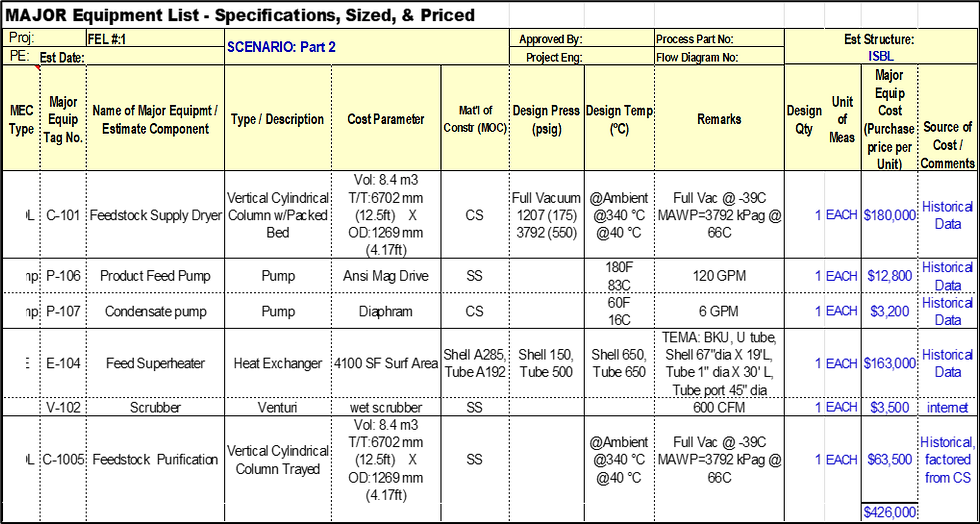
Table 3 – Summary of Major ISBL Equipment and Purchase Costs [2,3,4]
Table 3 summarizes the major process equipment identified from the conceptual process flow diagram and the corresponding purchase cost basis used for factoring. Equipment costs are expressed at a consistent reference date and exclude installation, freight, taxes, and duties.
ISBL EQP $ (in Table 2) = | $426,000 |
|
| |
Source | Fluid | Extended Cost | Included | Not Included |
Kinney | 5.08 | $2,164,000 | ISBL, Engrg, Owner, CSU |
|
RP 59R-10 | 5.04 | $2,147,000 | ISBL, Engrg, Owner | OSBL, CSU |
Navarrete & Cole | 6.00 | $2,556,000 | ISBL, Engrg, Owner | OSBL, CSU |
Kul Uppal AACEI | 6.21 | $2,645,000 | ISBL, Engrg, Owner | OSBL, CSU |
L. R. Dysert | 5.10 | $2,173,000 | ISBL, Engrg, Owner | OSBL, CSU |
Group Ave | 5.59 | $2,380,250 | ISBL, Engrg, Owner | OSBL, CSU |
LANG Final | 4.74 | $2,019,000 | ISBL, Engrg, "some offsites" | OSBL, Owner, CSU |
Perry's Chem Eng, | 4.80 | $2,045,000 | ISBL, Engrg | OSBL, Owner, CSU |
Compass | 4.63 | $1,972,000 | ISBL, Engrg | OSBL, Owner, CSU |
Group Ave | 4.72 | $2,012,000 | ISBL, Engrg | OSBL, Owner, CSU |
Overall Average | 4.16 | $1,772,000 |
|
|
USE: | 4.72 | $2,012,000 | ISBL, Engrg | OSBL, Owner, CSU |
Table 4 – ISBL Installed Cost Estimate Using Process Area Factors [2,3,4]
Table 4 applies ISBL process area factors to the aggregated equipment purchase costs to develop an estimated ISBL installed cost. The resulting estimate represents the installed cost of the process unit within its battery limits only and does not include OSBL facilities, owner costs, or commissioning and start up.
Strengths and Limitations of ISBL Process Area Factoring
ISBL process area factoring offers significant advantages at very early stages of project development. The method is fast, requires minimal input data, and provides reasonable cost visibility for screening and comparative evaluation of alternatives [2].
However, the method has inherent limitations. Because factors are applied at an aggregate level, the approach provides limited insight into individual equipment drivers and offers little transparency regarding scope distribution. Variations in equipment mix, layout complexity, and design standards are absorbed into a single factor, masking potential cost risks.
Most importantly, ISBL process area factoring does not capture OSBL facilities, owner costs, or commissioning and start up activities. When these exclusions are not explicitly recognized, early estimates may significantly understate total project cost [9].
These limitations do not invalidate the method, but they clearly define its appropriate application range.
Transition to Enhanced Factored Approaches
As project definition progresses and additional information becomes available, reliance on aggregate ISBL factors alone becomes increasingly restrictive. Improved transparency and scope control require methods that better reflect individual equipment characteristics and explicitly defined boundaries.
Conceptual Estimating Method 2: Equipment Factored Envelope (EFE)
Purpose and Context
As project definition progresses beyond simple screening, reliance on aggregate ISBL process area factors becomes increasingly restrictive. While Lang-type ISBL factors provide useful early visibility, they obscure the influence of individual equipment characteristics such as size, pressure, materials of construction, and installation complexity.
The Equipment Factored Envelope (EFE) approach supplements traditional ISBL factoring by shifting the primary cost driver from aggregated equipment cost to individual major equipment items, while maintaining a factored methodology appropriate for early-stage estimating [3,4,5].
Definition of the Equipment Factored Envelope
An Equipment Factored Envelope is defined as the physical and functional boundary surrounding an individual piece of major process equipment for estimating purposes. The envelope includes the equipment itself and the directly associated installation scope required for that equipment to operate as intended.
Typical envelope scope includes foundations, supports, piping shown on early P&IDs, local instrumentation, electrical connections, insulation, coatings, and associated field indirects. Shared infrastructure such as pipe racks, buildings, utilities, and site work are explicitly excluded and addressed separately [9].
Conceptual Illustration of the Equipment Factored Envelope
Figure 3 provides a simplified illustration of the Equipment Factored Envelope within an ISBL process unit boundary. The figure demonstrates how equipment-specific installation scope is captured while maintaining clear separation from shared infrastructure.

Figure 3 – Simplified Illustration of an Equipment Factored Envelope Within ISBL Boundaries [9]
Role of P and IDs in Defining the Envelope
Preliminary P&IDs provide the functional information required to define Equipment Factored Envelopes. Even at early stages, P&IDs typically identify equipment connections, control elements, instrumentation, and functional piping necessary to establish envelope limits [8].
Figure 4 illustrates an example equipment-level P&ID used to define the scope basis for an Equipment Factored Envelope. The figure is illustrative and not associated with the numerical examples that follow.

Figure 4 – Example Equipment P and ID Illustrating the Scope Basis for an Equipment Factored Envelope [8]
Application of Equipment Factored Envelope Methods
To demonstrate application of the Equipment Factored Envelope approach, individual major equipment items are evaluated using equipment-level factors.

Table 5 – Equipment Factored Estimate (EFE)
Table 5 presents an Equipment Factored Estimate developed using traditional equipment installation factors applied at the envelope level.

Table 6 – Equipment Factored Estimate with CERs (EFE)
Table 6 presents an alternative EFE developed using Cost Estimating Relationships consistent with AACE Recommended Practice 59R-10 [5].
Summary of Factor Comparison Results
To normalize results across the different estimating methods presented above, factor comparisons are summarized using a common purchased equipment cost basis.

Table 7 – A Summary of Factor Comparisons from all above tables
When the estimating approaches are normalized to a common purchased equipment cost basis, the resulting factor ranges converge more closely than is often assumed. The observed differences in total installed cost are driven primarily by scope boundary definition, treatment of indirect costs, and inclusion or exclusion of owner and commissioning elements, rather than by the estimating methodology itself.
Scope Inclusion Clarification Across Factored Methods
While Table 7 compares numerical outcomes, it is equally important to clarify how scope is treated under each factored estimating method. Misapplication of factors outside their intended boundaries is a common source of error in early-stage estimates.
What components are included in which cost factors? | Included in the LANG type ISBL Factor Cost Estimate? | Included in the Installed Estimated Major Equipmt Factor Cost (EFE)? |
The total installed EFE field cost of each piece of Major Equipment including all components shown on the preliminary P&IDs for each piece of Major Equipment (i. e. each column, tank, heat exchanger, etc.). Additionally, cost are required for the elements such as equipment connections, etc that remain to be identified and priced. | YES, but there’s more. The P&ID for each piece of major equipment represents finite boundaries that are too detailed to estimate in early estimating. All of those details are captured in the MEC cost factor. The Lang cost factor represents a collection of all P&ID components of several pieces of major equipment CONNECTED. | Yes. The MEC factor is specific to each piece of equipment and reflects the total purchase and field installed cost of everything normally shown on but limited to the preliminary P&ID envelopes. How? Multiply the MEC factor specific to each type of Major Equipment in the MEC chart times the purchase price of each piece of Major Equipment. |
The LANG Factor captures the INNER connecting Pipe Rack and Pipe connection costs for the designs located inside the geographical boundary of each individual AREA | Yes. All components on the rack including trays. These are grouped by Process categories identified in the BFDs or sometimes in the PFD’s. How? Multiply the purchase price of the major equipment times the ISBL factor. | No. These must be conceptually quantified separately, based on probable routing within the process area plan. |
The INTERCONNECTING Pipe Rack and Pipe located BETWEEN the individual AREAS | No. Each AREA boundary represents the geographical boundary of the limits of scope and cost. | No. The equipment P&ID is the basis for scope and cost limitations. |
Table 8 – Comparison of Scope Inclusion Between LANG ISBL Factors and Equipment Factored Estimates (EFE)
Table 8 clarifies which cost components are included within Lang-type ISBL process area factors and Equipment Factored Envelope methods, and which components must be quantified separately. This comparison reinforces boundary discipline and establishes a clear transition to consideration of OSBL, owner costs, and commissioning activities.
Extending The Framework Beyond ISBL
Need to Address OSBL, Engineering, Owner, and CSU Costs
The ISBL process area and Equipment Factored Envelope methods presented in Section 7 provide visibility into installed process unit costs. However, these methods alone do not represent the full scope required to deliver an operable facility. Outside Battery Limits facilities, engineering and owner costs, and commissioning and start-up activities represent significant portions of Total Installed Cost and Total Project Cost and must be addressed explicitly to avoid systematic understatement [9].
At early stages of project development, these cost elements are often treated inconsistently or omitted entirely. The intent of this section is to extend the factored estimating framework by incorporating these additional cost components in a transparent and conceptually consistent manner, without implying false precision.
Conceptual Treatment of OSBL Costs
For Equipment Factored Estimates, OSBL scope must be considered even when the site location and infrastructure configuration are not yet defined. At the initial stage of process engineering, OSBL costs are therefore captured conceptually using high-level factors informed by historical experience rather than detailed site layouts [1,9].
Two general approaches are commonly used. The first applies a high-level OSBL multiplier to the ISBL cost basis when little site-specific information is available, which is typical for greenfield projects developed on new sites. In such cases, a minimum OSBL factor on the order of 80 percent of ISBL cost is often used as a screening-level approximation. The second approach allows selective application of OSBL categories when the process engineer has sufficient insight into utilities, infrastructure, and offsites requirements.
OSBL factors represent on-site, non-process infrastructure costs and vary significantly from site to site. No two sites are the same. Typical conceptual OSBL ranges observed in practice include:
New greenfield sites developed as standalone facilities, typically ranging from approximately 60 to 120 percent of ISBL cost
New processes utilizing a combination of new and existing technology, typically ranging from approximately 40 to 60 percent
Incremental expansions utilizing existing plant technology, typically ranging from approximately 20 to 50 percent
Retrofit or revamp projects, typically ranging from approximately 12 to 30 percent
These ranges assume no prior pre-investment and reflect on-site cost considerations only.

Table 9 – OSBL Category Factors
This categorization reinforces that OSBL costs are inherently site-specific and weakly correlated to individual process equipment. Treating OSBL as a separate conceptual cost element, rather than embedding it implicitly within ISBL or equipment-level factors, improves transparency and reduces the risk of material understatement during early project screening.
Engineering, Construction Management, and Owner Costs
Project-level indirect costs include engineering, construction management, and owner costs. These elements are not fully captured by ISBL or Equipment Factored Envelope methods and must be addressed explicitly to ensure completeness of early-stage estimates.
Design and engineering costs include process design, detailed engineering, purchasing, procurement support, and construction supervision. For projects using existing or well-proven technology, engineering costs typically range from approximately 20 percent of ISBL direct and indirect field costs. For projects involving new or less mature technology, engineering costs may increase to approximately 30 percent of ISBL field costs. Engineering associated with OSBL facilities typically represents an additional 9 to 12 percent of OSBL field costs.
Construction management costs, when not included within an EPC contract, typically range from approximately 6 to 10 percent of total project field costs, including both ISBL and OSBL scope.
Owner costs represent real expenditures required to support project development and execution and often range from approximately 8 to 12 percent of total construction costs. Owner costs consist of both capital-related expenditures and early operating costs incurred during the first years of operation, including project oversight, owner engineering, furnishings, operational equipment such as forklifts and trucks, emergency response resources, initial chemical inventories, and financing-related costs. Some of these costs may also be identified separately within OSBL cost categories.
The inclusion of owner costs within project estimates varies by organization based on accounting practices and taxation rules. Transparency regarding treatment of owner costs is therefore essential when presenting conceptual estimates. Overall owner engineering effort, including process engineering and project oversight, is typically limited to approximately 8 percent of total field costs when using the Equipment Factored Envelope framework illustrated in the following example.
· Benchmarked by Kinney 1995 to 2025

Table 10 – Breakdown of Engineering Costs [6,7]
The distribution of engineering effort across project phases highlights why simplified factored methods alone are insufficient to represent total project cost. Explicit recognition of engineering and project-level indirect costs improves alignment between early estimates and eventual project execution realities.
Treatment of Escalation at the Conceptual Stage
Escalation is typically not applied at this level of estimate. Conceptual cost estimates are developed in current-year dollars, reflecting the date of estimate rather than a future execution date.
At early stages of project development, adding escalation can introduce confusion and distort investment decision making. Investors generally develop their investment plans using present-day cost comparisons until a target execution date or decision to proceed has been established. Escalation can be incorporated later as project schedules and execution timing become better defined.
Contingency and Commissioning and Start-Up Costs
Contingency is applied at the end of the capital cost estimate after all field costs, including ISBL and OSBL, as well as engineering and owner costs, have been incorporated. When escalation is included, contingency is applied after escalation.
Contingency allowances should be defensible and based on experience, project complexity, and maturity. Development of a contingency drawdown plan is an effective method for supporting contingency requirements and demonstrating alignment with risk exposure. While achieving a P50 confidence level is often the baseline objective, contingency beyond that level may be justified by extenuating project-specific drivers.
Commissioning and start-up costs must be isolated from construction costs and can range from approximately 4 to 15 percent of Total Installed Cost. These costs include development of operating manuals, formal operator and staff training, interim start-up fuels, line and equipment purging, and staged system testing required to safely transition the facility to operation.
Illustrative Total Project Cost Development
By integrating ISBL costs, conceptual OSBL allowances, engineering and owner costs, contingency, and commissioning and start-up considerations, the factored estimating framework can be extended to develop an illustrative Total Project Cost suitable for early decision making.

Table 11 – ALL FLUID Process EFE TPC (Using 59R-10 Factors)
This illustrative roll-up demonstrates that extending Equipment Factored Estimates beyond ISBL scope requires deliberate treatment of OSBL facilities, engineering, owner costs, contingency, and commissioning and start-up. The intent is to support informed early-stage decision making while maintaining transparency regarding scope inclusion and exclusion, rather than to imply deterministic accuracy.
Conclusions and Key Takeaways
The examples presented confirm that disciplined application of factored estimating methods, combined with explicit boundary definition, is more critical to estimate credibility than selection of any single estimating technique.
This paper demonstrates that traditional Lang-type ISBL process area factors and Equipment Factored Envelope (EFE) methods are not competing approaches, but complementary tools when applied within their intended boundaries and supplemented appropriately. Each method provides value at different levels of project definition and decision making.
Lang-type ISBL factors remain effective for early screening when minimal process definition is available and when estimates are required quickly to support concept selection. However, as project definition progresses and preliminary P&IDs become available, reliance on aggregated process area factors alone can obscure important cost drivers and lead to misinterpretation of scope coverage.
The Equipment Factored Envelope approach bridges this gap by shifting the primary cost driver to individual pieces of major equipment while retaining a factored methodology appropriate for early-stage estimating. By defining clear envelope boundaries around each major equipment item, EFE methods improve transparency, enable better normalization across estimating approaches, and reduce ambiguity regarding what is included and excluded from the estimate.
The comparative examples presented in this paper demonstrate that when estimating methods are normalized to a common equipment cost basis and applied consistently, the resulting installed cost factors converge more closely than is often assumed. Differences in total cost outcomes are driven less by the choice of estimating method and more by scope definition discipline, boundary clarity, and treatment of indirect costs.
Extending the framework beyond ISBL to explicitly address OSBL facilities, engineering effort, owner costs, contingency, and commissioning and start-up activities is essential for developing credible early-stage estimates. These cost elements are weakly correlated to individual equipment costs and must be treated separately to avoid systematic understatement of Total Installed Cost and Total Project Cost.
The framework presented in this paper reinforces several key principles for conceptual estimating. Factored methods must be applied only within their intended scope boundaries. All major cost components should be explicitly acknowledged, even when quantified conceptually. Transparency regarding inclusions and exclusions is more important than apparent precision at early stages of project development.
When applied with discipline, Equipment Factored Envelope methods provide a practical and defensible means of supplementing traditional Lang-type estimates. Together, these approaches support more informed investment decisions, reduce misunderstanding between stakeholders, and improve confidence in early-stage project cost forecasts.
References
[1] The Rand Corporation, “Cost Estimating Relationships,” U.S. Airforce, R-761-PR Abridged, February 1972
[2] Lang, H. J., “Simplified Approach to Preliminary Cost Estimates,” Chemical Engineering, June 1948, PP. 112-113
[3] W. E. Hand., “From Flowsheet to Cost Estimate,” Cost Engineers Notebook, Morgantown, WV, AACEI International 1964
[4] K. M. Guthrie, W. R. Grace & Co., “Capital Cost Estimating”, Chemical Engineering, March 24, 1969, pp. 114-142
[5] AACE International, Recommended Practice No. 59R-10, Development of Factored Cost Estimates – As Applied in Engineering, Procurement, and Construction For The Process Industries, AACE International, Morgantown, WV, June 18, 2011, “Equipment Factored Estimates (EFE)”
[6] AACE International, Recommended Practice No. 10S-90, Cost Engineering Terminology, AACE International, Morgantown, WV, July 24, 2024
[7] Kinney, C. L., “Part 2: Project Development: Cost Conceptual Development Concepts and Risks,” MIT ChemE Post-grad School of Practice, 10.801 Project Value Module, MIT Cambridge ChemE Library, Jan 2023
[8] Douglas, J. M., MIT, “Conceptual Design of Chemical Processes,” McGraw-Hill, 1988, pg. 25, “Flowsheet and Stream Table”
[9] Christopher L. Kinney and Rafaele Gauche, “EST.21 What’s in ISBL, OSBL, and The Factors”, 2006 AACE International Transactions


Comments